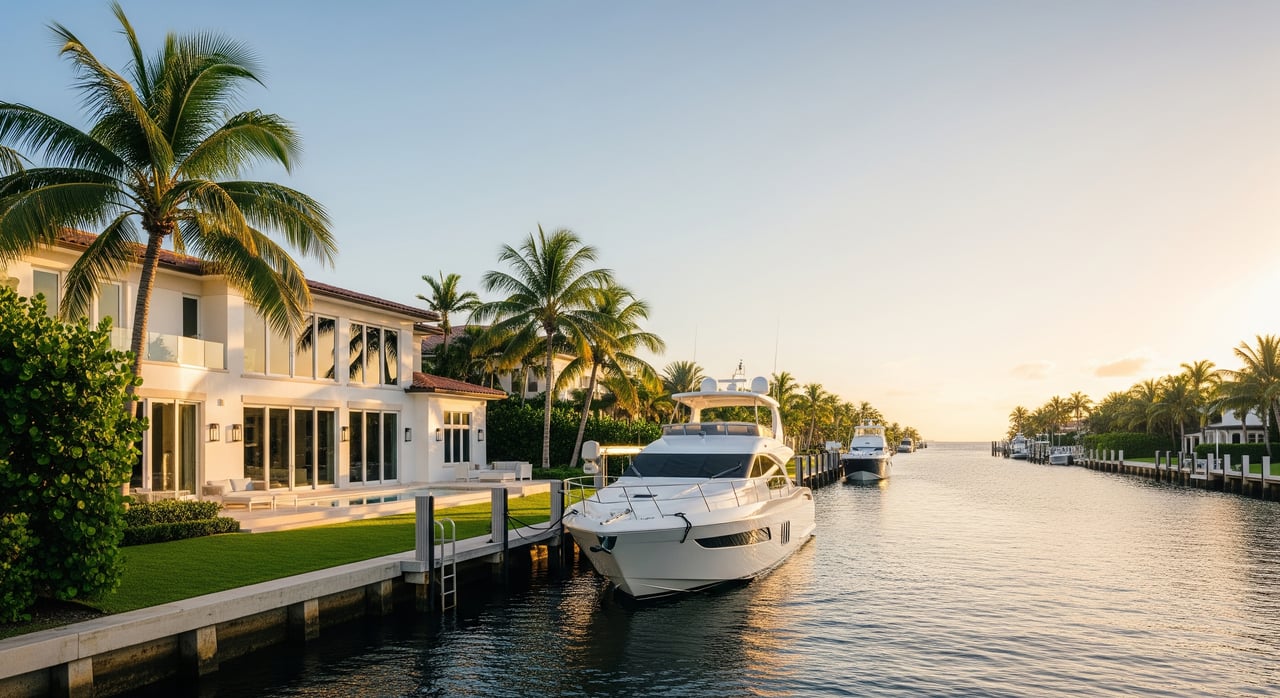
Shopping Bel Marra for a waterfront home but unsure if you need deepwater or just ocean access? You are not alone. When you own a boat, the wrong canal or bridge can turn a dream dock into a daily headache. This guide breaks down how deepwater and ocean-access differ, what matters in Bel Marra’s canals, and the steps to verify a property for your specific vessel. Let’s dive in.
Deepwater vs ocean-access, simplified
Deepwater means the water at your dock is deep enough at normal low tide to keep your boat afloat without timing departures to tides or paying for frequent dredging. What counts as “enough” depends on your boat’s draft plus a safety margin, typically measured against local low-water datums.
Ocean-access means you can navigate from your dock to the Atlantic Ocean. You may pass through fixed bridges, drawbridges, or open routes along the Intracoastal Waterway. A property can be ocean-access but not deepwater, or deepwater but still challenging for larger vessels if bridges or tight turns limit passage.
Bel Marra boating basics
Bel Marra sits in Boca Raton on canals that feed into the Intracoastal Waterway, then out to ocean inlets. You should look closely at canal geometry, any local dredging history, the seawall and dock condition, and routes to the inlet. South Florida tides are modest, often around 1–2 feet, but that swing still affects usable depth and under‑keel clearance.
What really matters for your boat
Water depth where you dock
Start with your vessel’s draft, then add a safety margin. Many surveyors recommend at least 1–2 feet of under‑keel clearance for cruisers in protected canals. Larger or heavier boats often plan for 10–20 percent of draft or a 2–3 foot absolute margin. Confirm depth at low tide near the dock and along your approach.
Bridges: clearance and openings
Check every bridge between your dock and the ocean. For fixed bridges, your air draft plus a safety margin must be below the posted vertical clearance at the relevant tidal datum, often mean high water. For drawbridges, confirm opening schedules and any notice requirements so you can plan reliably.
Canal width and turning room
Canal width and turning space set a practical limit on boat size, especially in crosswinds or current. As general guidance:
- Small runabouts and center consoles under 26 feet can manage in narrower canals around 20–30 feet wide if depth is adequate.
- Mid‑size express cruisers in the 26–40 foot range prefer at least 30–45 feet of clear channel width with reasonable turning room.
- Larger sportfish and convertibles over 40 feet often require 50 feet or more of width, deeper water at the dock (commonly 6–8 feet at low water depending on draft), and unobstructed approaches.
Many captains plan for a working turning radius of roughly 1–2 times the boat’s length in calm conditions. Tight canals, wind, or current call for more margin.
Proximity to the inlet
Shorter runs to the inlet can be safer and more convenient. Consider actual navigable distance along the Intracoastal, not just a straight line. Factor in bridge clearances, typical currents near inlet approaches, and whether the route uses maintained channels.
Match your vessel to Bel Marra canals
Use these conservative pairings as a starting point. Always verify at the property.
Small dayboat, center console, jet boat, small bowrider (under 26 ft, draft under 2 ft)
- Needs: 2–3 ft at low water; narrow canals often fine.
- Tips: Focus on dock orientation and easy maneuvering.
Express cruiser or family cruiser (26–40 ft, draft 2–4 ft)
- Needs: 3–5 ft at low water and 30–45 ft of channel width.
- Tips: Confirm depth at mean low water at your dock and along the approach; check bridge clearances.
Sportfisher, convertible, large flybridge (40–60+ ft, draft 3–6 ft)
- Needs: 5–8+ ft at low water, 50+ ft canal width, and clean access to the Intracoastal.
- Tips: Prioritize confirmed deepwater soundings and routes that avoid low fixed bridges.
Sailboats and multihulls
- Needs: Adequate depth at the dock plus careful vertical clearance checks for fixed bridges.
- Tips: Compare air draft to posted bridge heights at mean high water and allow a safety margin for tides and wave action.
How to verify a Bel Marra property
Follow this step-by-step when you tour or go under contract:
- Gather waterfront documents
- Request as‑built dock drawings, any bathymetry or soundings, and dock or lift permits. Check county records for seawall age, permits, and your waterfront footage.
- Confirm charted depths and tides
- Review nautical charts for local soundings and the chart datum. Translate charted depths to usable depth at your local low tide using tide tables. If private canals lack recent soundings, arrange an in‑water survey by a marine surveyor or licensed diver.
- Map bridges and clearances
- Identify all bridges on your route to the ocean. Verify which are fixed versus opening, posted vertical clearances and the datum used, and any opening schedules or restrictions.
- Ask about dredging and maintenance
- Request records for any dredging: last date, scope, and permits. Check whether there are planned projects from local or federal agencies.
- Inspect seawall, dock, and lift
- Order a structural inspection for seawall and dock piles, decking, and lift capacity. Confirm that the dock configuration and lift are permitted and meet your vessel’s size and weight.
- Hire local experts
- Marine surveyor: in‑water soundings, obstructions, and mooring gear.
- Local captain or yacht professional: test maneuvering under typical wind and current when possible.
- Insurance agent: pre‑underwriting review for your boat at that dock.
Permits, insurance, and ongoing care
- Dock and seawall permits and riparian rights. Confirm that the existing structures are permitted and that local rules allow your preferred dock or lift configuration. Some communities regulate vessel types and dock layouts.
- Dredging responsibility. Public efforts usually focus on maintained navigation channels. Lateral canals near private docks may be the owner’s or HOA’s responsibility. Clarify who pays and how often.
- Insurance and underwriting. Carriers often review seawall integrity, proximity to open water, and demonstrated usable depth at your dock. Get an early read on insurability and premiums.
- Flood and elevation. Review flood maps and base flood elevations to understand storm surge exposure and any implications for coverage.
Smart buyer tips for Bel Marra
- Know your numbers: draft, air draft, LOA, beam, and desired under‑keel margin.
- Visit at low tide if possible to see real clearance at your dock and along the approach.
- Walk the canal edge and count obstructions like pilings, lift poles, and vegetation that could limit turning.
- Ask neighbors and local captains about any shoaling or tricky turns along your route to the Intracoastal.
- Plan for maintenance: even deep canals can shift over time. Budget for periodic inspections and potential dredging.
Work with a waterfront specialist
The right Bel Marra home should fit your lifestyle and your boat. Our team pairs local waterway knowledge with a concierge process that coordinates surveyors, inspectors, and insurance so you can close with confidence. Ready to zero in on the streets and docks that match your vessel and your goals? Connect with Dana Ocampo for a private consultation.
FAQs
What does deepwater mean for a 36-foot cruiser in Bel Marra?
- You typically want your draft plus 1–2 feet of clearance at local low tide; for many 36-foot cruisers with 2–3 ft draft, look for about 4–6 ft at low water near the dock and verify with a sounding.
Is a canal-to-Intracoastal route considered ocean access in Boca Raton?
- Yes, if you can navigate from your dock to the ocean with adequate depth and bridge clearances, including any drawbridge openings needed along the route.
How do I confirm if a fixed bridge blocks my sailboat’s mast?
- Compare your air draft to the bridge’s posted vertical clearance at the stated tidal datum (often mean high water) and keep a safety margin for tides and wave action.
Who typically pays to dredge near a private Bel Marra dock?
- It varies. Public dredging usually targets maintained channels; private lateral canals are often the owner’s or HOA’s responsibility, subject to permits and local rules.
What inspections should I complete before closing on a waterfront home?
- Arrange a marine survey with in‑water soundings, a structural inspection of seawall, dock, and lift, a review of permits and dredging records, and confirmation of any HOA restrictions affecting your vessel or dock changes.